
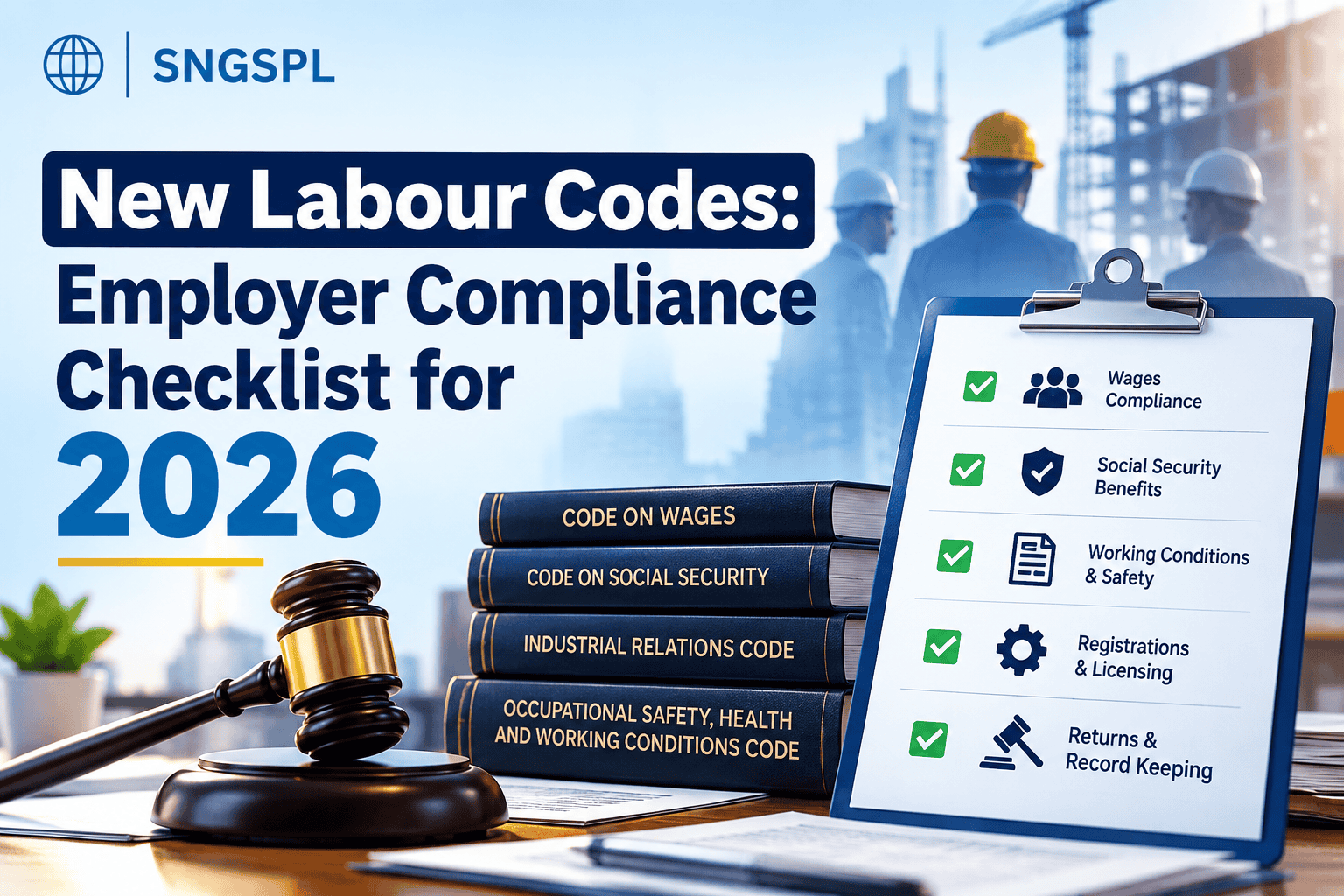
India’s labour law framework has undergone a major change with the implementation of the four Labour Codes. For employers, 2026 is an important year to review payroll structures, employment documentation, statutory registers, contractor compliance, workplace policies and other labour-law obligations.
The four Labour Codes consolidate 29 existing central labour laws into four broad areas:
This approach allows management to identify compliance gaps and assign responsibility for corrective action.
- Code on Wages, 2019
- Industrial Relations Code, 2020
- Code on Social Security, 2020
- Occupational Safety, Health and Working Conditions Code, 2020
1. Review Your Salary and Wage Structure
One of the most important areas under the Labour Codes is the definition of “wages.” The Code on Wages generally includes basic pay, dearness allowance, retaining allowance, special allowance and employer PF within wages, while excluding certain components subject to the statutory framework. The Code also contains a provision requiring certain amounts to be added back to wages when excluded components exceed the prescribed proportion of remuneration. The Ministry of Labour and Employment’s 2026 FAQ also clarifies certain components relevant to the 50% calculation, including treatment of overtime and specified statutory contributions.Employer checklist:
- Review the salary structure of employees.
- Identify the components included in wages.
- Check whether allowances are structured appropriately.
- Review the impact on PF and other statutory contributions where applicable.
- Recalculate statutory benefits where the wage definition affects their computation.
- Check CTC and payroll structures after applying the applicable rules.
- Maintain proper documentation for salary revisions.
2. Review Appointment Letters and Employment Documentation
Employers should ensure that employees receive appropriate employment documentation containing relevant terms and conditions of employment. The Labour Codes place greater emphasis on standardised employment-related documentation and records.Employers should review:
- Appointment letters
- Employment agreements
- Job descriptions
- Salary structures
- Working hours
- Leave provisions
- Probation clauses
- Notice-period provisions
- Transfer provisions
- Confidentiality clauses
- Disciplinary procedures
- Statutory benefits
3. Check Working Hours, Overtime and Leave Records
Working hours, weekly holidays, overtime and annual leave are important areas covered under the Occupational Safety, Health and Working Conditions framework. The OSH Code includes provisions dealing with daily and weekly working hours, annual leave, overtime, night shifts and maintenance of employment records.Compliance checklist:
- Maintain accurate attendance records.
- Track working hours.
- Maintain overtime records.
- Review overtime calculations.
- Maintain weekly-off records.
- Track leave balances.
- Review compensatory-off records where applicable.
- Ensure overtime payments are calculated correctly.
- Review shift and night-work arrangements.
4. Review PF, ESI and Other Social Security Compliance
The Social Security Code brings several social-security provisions under a consolidated framework. Employers should review their existing processes for:- Provident Fund
- Employees’ State Insurance
- Gratuity
- Maternity-related benefits
- Employee records
- Social-security contributions
- Other applicable statutory benefits
Employer action:
Conduct a payroll compliance audit and compare: Current salary structure → Applicable wage definition → Statutory contribution → Employee benefit calculation This exercise can help identify discrepancies before they become compliance issues.5. Review Gratuity Calculations
Gratuity is another area that should be reviewed as part of a Labour Code compliance exercise. Employers should check:- Employee eligibility
- Continuous service records
- Last drawn wages used for calculation
- Fixed-term employment arrangements
- Contractor and employee classification
- Gratuity provisions in employment documentation
- Payroll and accounting treatment
6. Audit Contract Labour Compliance
Contract labour can create significant compliance responsibilities for both principal employers and contractors. Employers using security guards, housekeeping staff, facility-management workers, production workers, logistics personnel or other outsourced manpower should review their contractor-management process.Contract labour checklist:
- Maintain a list of all contractors.
- Verify contractor registrations/licences as applicable.
- Check contractor employee records.
- Verify wage payments.
- Review PF and ESI compliance where applicable.
- Collect statutory challans and returns.
- Verify attendance records.
- Maintain contractor agreements.
- Monitor deployment of contract workers.
- Conduct periodic contractor compliance audits.
7. Review Workplace Health and Safety Requirements
Workplace safety is a major component of the OSH framework. Depending on the nature of the establishment, employers should review:- Health and safety policies
- Workplace risk assessments
- Safety training
- Personal protective equipment
- Emergency procedures
- First-aid facilities
- Fire-safety arrangements
- Accident reporting
- Safety committees where applicable
- Health examinations where required
- Welfare facilities
8. Check Registers, Records and Returns
A compliance framework is incomplete without proper documentation. The OSH Code specifically provides for maintenance of registers, records and filing of returns. Employers should review whether their records are:- Accurate
- Updated
- Properly maintained
- Available for inspection
- Consistent with payroll data
- Consistent with attendance records
- Consistent with employee master data
9. Review Industrial Relations Policies
The Industrial Relations Code is another major component of the new labour-law framework. Employers should review their processes relating to:- Standing orders where applicable
- Disciplinary procedures
- Grievance handling
- Termination procedures
- Retrenchment
- Lay-off requirements
- Worker representation
- Industrial disputes
- Internal employment policies
10. Review POSH and Other Workplace Policies
The Labour Codes do not replace every workplace-related law. Employers should therefore avoid treating Labour Code compliance as a complete replacement for all other statutory obligations. For example, organisations should continue reviewing applicable requirements relating to:- Prevention of Sexual Harassment (POSH)
- Maternity benefits
- State-specific labour requirements
- Shops and Establishments requirements
- Professional Tax
- Labour Welfare Fund
- Minimum wage notifications
- Contractor compliance
- Factory-specific requirements
11. Check State-Specific Requirements
This is one of the most important points for employers in 2026. The Labour Codes provide a national framework, but employers should not assume that one compliance checklist automatically applies to every business across India. The applicable rules can depend on whether the Central Government or the relevant State Government is the appropriate authority. Therefore, before implementing changes, employers should check: State → Industry → Establishment type → Employee strength → Worker category → Applicable rules For businesses operating in multiple states, this becomes even more important because compliance requirements may differ between locations.12. Conduct a Labour Compliance Gap Analysis
Instead of checking individual requirements randomly, employers can conduct a structured labour compliance audit. A simple 2026 gap-analysis framework can be:| Compliance Area | Current Status | Gap Identified | Action Required |
|---|---|---|---|
| Salary Structure | Reviewed/Not Reviewed | Wage structure issue | Recalculate |
| Appointment Letters | Reviewed/Not Reviewed | Missing clauses | Update format |
| PF/ESI | Reviewed/Not Reviewed | Contribution mismatch | Correct payroll |
| Gratuity | Reviewed/Not Reviewed | Calculation gap | Review |
| Contract Labour | Reviewed/Not Reviewed | Documentation gap | Audit contractors |
| Working Hours | Reviewed/Not Reviewed | Record gap | Improve tracking |
| Overtime | Reviewed/Not Reviewed | Calculation issue | Review payroll |
| Leave Records | Reviewed/Not Reviewed | Record gap | Update system |
| Safety | Reviewed/Not Reviewed | Policy gap | Implement controls |
| Registers & Returns | Reviewed/Not Reviewed | Missing records | Update compliance |
| HR Policies | Reviewed/Not Reviewed | Outdated policy | Revise |
| State Compliance | Reviewed/Not Reviewed | State-specific gap | Verify requirements |
13. Create a Monthly Compliance Calendar
Labour compliance should not be treated as a once-a-year activity. HR and compliance teams should maintain a monthly calendar covering:- Payroll compliance
- PF/ESI requirements
- Professional Tax where applicable
- Labour Welfare Fund requirements where applicable
- Attendance and wage records
- Contractor compliance
- Statutory returns
- Licence renewals
- Employee documentation
- Inspection-related records
14. Keep Evidence of Compliance
One of the most overlooked areas is maintaining evidence. An organisation may have completed a statutory activity but still struggle during an audit if supporting documents cannot be produced. Maintain organised records of:- Payroll registers
- Attendance
- Wage sheets
- Statutory challans
- Returns
- Employee records
- Contractor documents
- Licences
- Inspection reports
- Safety records
- Policies
- Training records
- Grievance documentation
2026 Labour Code Employer Checklist
Before closing your compliance review, ask: ☐ Have we reviewed our salary structure? ☐ Have we checked the applicable definition of wages? ☐ Have we reviewed appointment letters? ☐ Are PF and ESI processes being correctly followed? ☐ Have we reviewed gratuity calculations? ☐ Are working hours and overtime properly recorded? ☐ Are leave records updated? ☐ Have we audited contract labour compliance? ☐ Are workplace safety requirements being followed? ☐ Are statutory registers and records properly maintained? ☐ Have we reviewed applicable Industrial Relations requirements? ☐ Are our HR policies updated? ☐ Have we checked state-specific labour requirements? ☐ Do we have a monthly compliance calendar? ☐ Can we produce documentary evidence of compliance?Why Labour Compliance Audits Matter in 2026
The Labour Codes are intended to simplify and consolidate India’s labour-law framework, but implementation still requires businesses to translate statutory requirements into practical HR, payroll and operational processes. A compliance audit can help employers identify gaps in:- Payroll
- Employee documentation
- Statutory contributions
- Contractor management
- Working hours
- Safety
- Registers and records
- HR policies
- State-specific requirements