
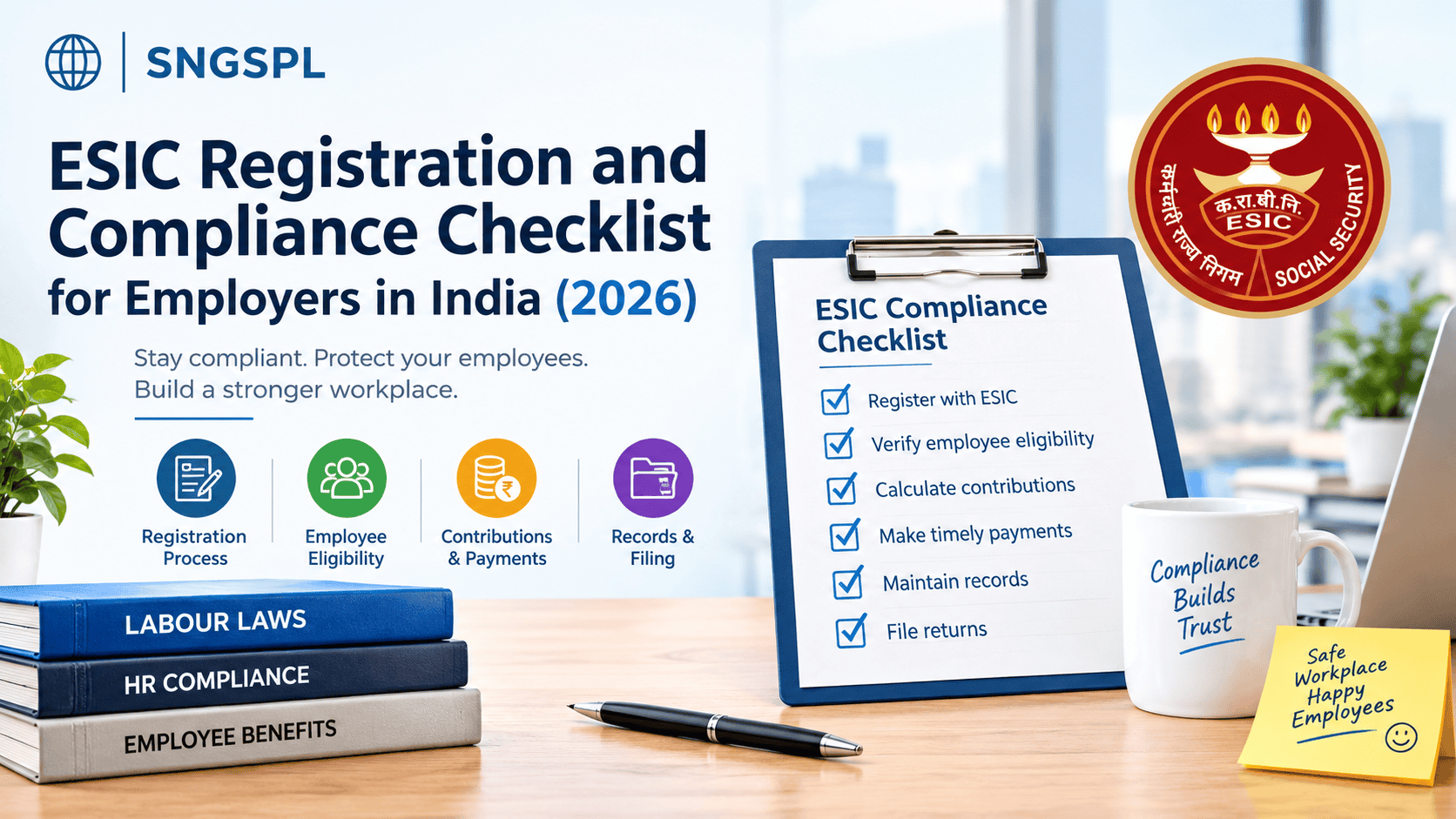
ESIC registration and compliance are important statutory responsibilities for employers in India. The Employees’ State Insurance (ESI) Scheme provides eligible employees with medical care and financial protection during sickness, maternity, employment injury, disability and other qualifying circumstances.
For businesses employing eligible workers/employees, understanding ESIC registration requirements, contribution rates, payment deadlines and statutory responsibilities is essential to avoid compliance issues.
Whether you operate a manufacturing unit, an office, a service organisation or a commercial establishment, maintaining proper ESIC records helps ensure employee welfare and smooth business operations.
In this guide, we explain the ESIC registration process in India, eligibility requirements, documents required, contribution rates and a practical ESIC compliance checklist for employers in 2026.
The exact document requirements may vary depending on the establishment type and registration procedure.
The employer is responsible for depositing both contributions with ESIC within the prescribed timeline.
Employers should maintain a monthly compliance calendar to avoid missing contribution deadlines.
Late payment may attract interest and other applicable consequences.
What Is ESIC?
The Employees’ State Insurance Corporation (ESIC) is a statutory organisation under the Ministry of Labour and Employment, Government of India. It administers the Employees’ State Insurance Scheme, which provides social security and healthcare benefits to eligible employees and their families. The scheme is designed to protect employees against financial difficulties arising from sickness, maternity, employment-related injuries and other covered circumstances. ESIC provides several important benefits, including:- Medical Benefit: Medical care and treatment for insured employees and eligible family members.
- Sickness Benefit: Cash benefits during qualifying periods of sickness.
- Maternity Benefit: Financial assistance to eligible insured women during maternity.
- Disablement Benefit: Benefits in cases of temporary or permanent disablement caused by employment injury.
- Dependants’ Benefit: Financial support to eligible dependants in the event of an employee’s death due to employment injury.
- Funeral Expenses: Financial assistance towards funeral expenses, subject to applicable conditions.
Who Needs ESIC Registration in India?
ESIC applicability depends on the type of establishment, number of employees, nature of operations and applicable statutory provisions. Under the Code on Social Security, 2020, which came into force on 21 November 2025, the ESI framework has been expanded. Important applicability provisions include:- ESIC coverage has been extended across India.
- Establishments employing 10 or more employees generally fall within the applicable coverage framework.
- Establishments with fewer than 10 employees may opt for voluntary ESIC coverage.
- Establishments carrying out notified hazardous or life-threatening occupations may be covered even if they employ a single employee.
Which Establishments May Require ESIC Registration?
Depending on applicability, ESIC coverage may include:- Factories and manufacturing establishments.
- Shops and commercial establishments.
- Hotels and restaurants.
- Private educational institutions.
- Medical establishments.
- Offices and service-sector organisations.
- Other establishments covered under the applicable provisions.
ESIC Employee Wage Limit in India
The wage ceiling is an important factor in determining employee eligibility for ESIC coverage. Under the existing operational ESI framework, the commonly applicable wage ceiling is:- ₹21,000 per month for employees.
- ₹25,000 per month for employees with disabilities.
ESIC Registration Process in India
Employers can complete ESIC registration through the official ESIC online portal. The registration process generally involves the following steps:Step 1: Visit the Shramsuvidha Website
Visit the official Shramsuvidha Website: https://shramsuvidha.gov.in/ Access the employer services section and proceed with the applicable registration facility.Step 2: Enter Establishment Details
Provide the necessary establishment information, including:- Name of the establishment.
- Type of business.
- Registered office address.
- Date of commencement.
- Nature of business activities.
- Number of employees.
- PAN and other applicable business identification details.
Step 3: Provide Employer Information
Enter the details of the employer, principal employer or authorised representative, as applicable. Ensure that the information matches the supporting documents.Step 4: Submit Required Documents
Upload the necessary documents and complete the registration application.Step 5: Obtain ESIC Registration Number
After successful registration, the establishment receives its ESIC employer registration number. This number is used for future compliance activities, including employee registration, contribution payments and statutory filings.Step 6: Register Eligible Employee/Workers
Employers must add eligible employees to the ESIC portal. Employee details generally include:- Employee name.
- Date of birth.
- Date of joining.
- Aadhaar details, where applicable.
- Residential address.
- Family details.
- Wage information.
- Bank account information, where required.
Documents Required for ESIC Registration
Employers should keep the following documents ready before starting the registration process.| Document | Purpose |
| PAN Card | Business identification |
| Certificate of Incorporation / Registration | Establishment proof |
| GST Registration Certificate | Business registration details, where applicable |
| Address Proof | Registered office or establishment address |
| Bank Account Details | Banking and payment information |
| Employee Details | Employee registration |
| Salary and Wage Records | Contribution calculation |
| List of Directors or Partners | Employer identification |
| Digital Signature / Authorised Signatory Details | Online application authentication, where required |
| Business Activity Details | Establishment classification |
ESIC Contribution Rates in India (2026)
ESIC contributions are shared between employers and employees. Under the existing prescribed contribution rates:| Contribution | Rate |
| Employer Contribution | 3.25% |
| Employee Contribution | 0.75% |
| Total Contribution | 4% |
Example of ESIC Contribution Calculation
Suppose an eligible employee receives monthly wages of ₹18,000. The contribution calculation would be: Employee Contribution ₹18,000 × 0.75% = ₹135 Employer Contribution ₹18,000 × 3.25% = ₹585 Total Monthly ESIC Contribution ₹135 + ₹585 = ₹720 Therefore, the total monthly ESIC contribution for this employee would be ₹720. The contribution must be calculated using the applicable statutory wage definition and rules.ESIC Payment Due Date
Employers must deposit ESIC contributions within the prescribed timeline. Under the existing ESI General Regulations, contributions are generally payable within 15 days from the end of the relevant calendar month. For example:| Contribution Month | General Payment Deadline |
| April 2026 | 15 May 2026 |
| May 2026 | 15 June 2026 |
| June 2026 | 15 July 2026 |
| July 2026 | 15 August 2026 |
ESIC Compliance Checklist for Employers
Maintaining ESIC compliance requires regular monitoring of employee records, contribution calculations and statutory payments. Here is a practical checklist for employers and HR departments.1. Registration Compliance
- Check whether the establishment falls under ESIC coverage.
- Complete employer registration.
- Obtain the ESIC employer registration number.
- Verify establishment details.
- Update changes in business or establishment information.
2. Employee Registration
- Identify all eligible employees.
- Register new eligible employees.
- Verify employee personal details.
- Ensure correct date of joining.
- Maintain employee insurance numbers.
- Update employee information whenever required.
3. Monthly Contribution Compliance
- Calculate eligible employees’ wages.
- Verify applicable contribution rates.
- Calculate employer contributions.
- Deduct the employee’s share correctly.
- Deposit contributions within the prescribed deadline.
- Download and maintain payment challans.
4. Payroll Compliance
- Reconcile ESIC wages with payroll records.
- Check employee eligibility against the applicable wage ceiling.
- Review overtime and other wage components according to applicable rules.
- Maintain monthly salary registers.
- Verify employee additions and exits.
5. Record Maintenance
- Maintain employee registration records.
- Maintain monthly contribution records.
- Preserve ESIC payment receipts.
- Maintain wage and attendance registers.
- Keep employee joining and exit records updated.
- Maintain relevant statutory documents for inspection.
6. Employee Welfare and Benefit Support
- Inform employees about their ESIC insurance numbers.
- Guide eligible employees on accessing medical benefits.
- Support employees with applicable maternity and sickness benefit procedures.
- Update employee and family details where required.
- Assist with employment injury reporting and related procedures.
Common ESIC Compliance Mistakes Employers Should Avoid
Even organisations with dedicated HR and payroll teams can make mistakes while managing ESIC compliance. Some common issues include:1. Failure to Register the Establishment
Employers sometimes delay registration despite meeting the applicable coverage requirements. This can create statutory compliance risks.2. Not Registering Newly Joined Employees
Eligible employees should be registered appropriately when they join the establishment. Missing employee registrations can result in incorrect contribution records and benefit-related complications.3. Incorrect Contribution Calculation
Errors in wage calculations or employee eligibility can lead to incorrect monthly contributions. Employers should review payroll data before submitting contributions.4. Missing Contribution Deadlines
Late payment may result in interest and other consequences under applicable provisions.5. Incorrect Employee Information
Incorrect personal details, dates of joining or insurance information can create difficulties when employees access ESIC benefits.6. Poor Documentation
Failure to maintain payment receipts, employee details, salary registers and other statutory records can create difficulties during inspections and audits.7. Ignoring Changes in Labour Laws
The introduction of the Code on Social Security, 2020 has changed the broader social security compliance framework. Employers should monitor applicable notifications, rules and transitional arrangements rather than relying entirely on outdated compliance practices.Penalties for Non-Compliance with ESIC Requirements
Failure to comply with applicable ESIC requirements can result in financial and legal consequences. Depending on the nature of the violation, consequences may include:- Interest on delayed contributions.
- Damages for delayed payment, where applicable.
- Recovery proceedings for outstanding contributions.
- Prosecution for specified statutory violations.
- Other penalties prescribed under applicable legislation.
How SNGSPL Helps Businesses with ESIC Compliance
Managing ESIC compliance involves more than simply depositing monthly contributions. Employers must ensure correct employee registration, payroll reconciliation, statutory documentation and timely payments. For organisations without dedicated compliance teams, these responsibilities can become challenging. SNGSPL helps businesses manage their statutory compliance requirements through professional compliance support and advisory services. Our ESIC compliance assistance can support businesses with:- ESIC registration assistance.
- Employee registration and documentation support.
- Monthly ESIC contribution compliance.
- Payroll and contribution reconciliation.
- ESIC statutory record maintenance.
- Compliance reviews and advisory support.
- Assistance with applicable ESIC requirements.