
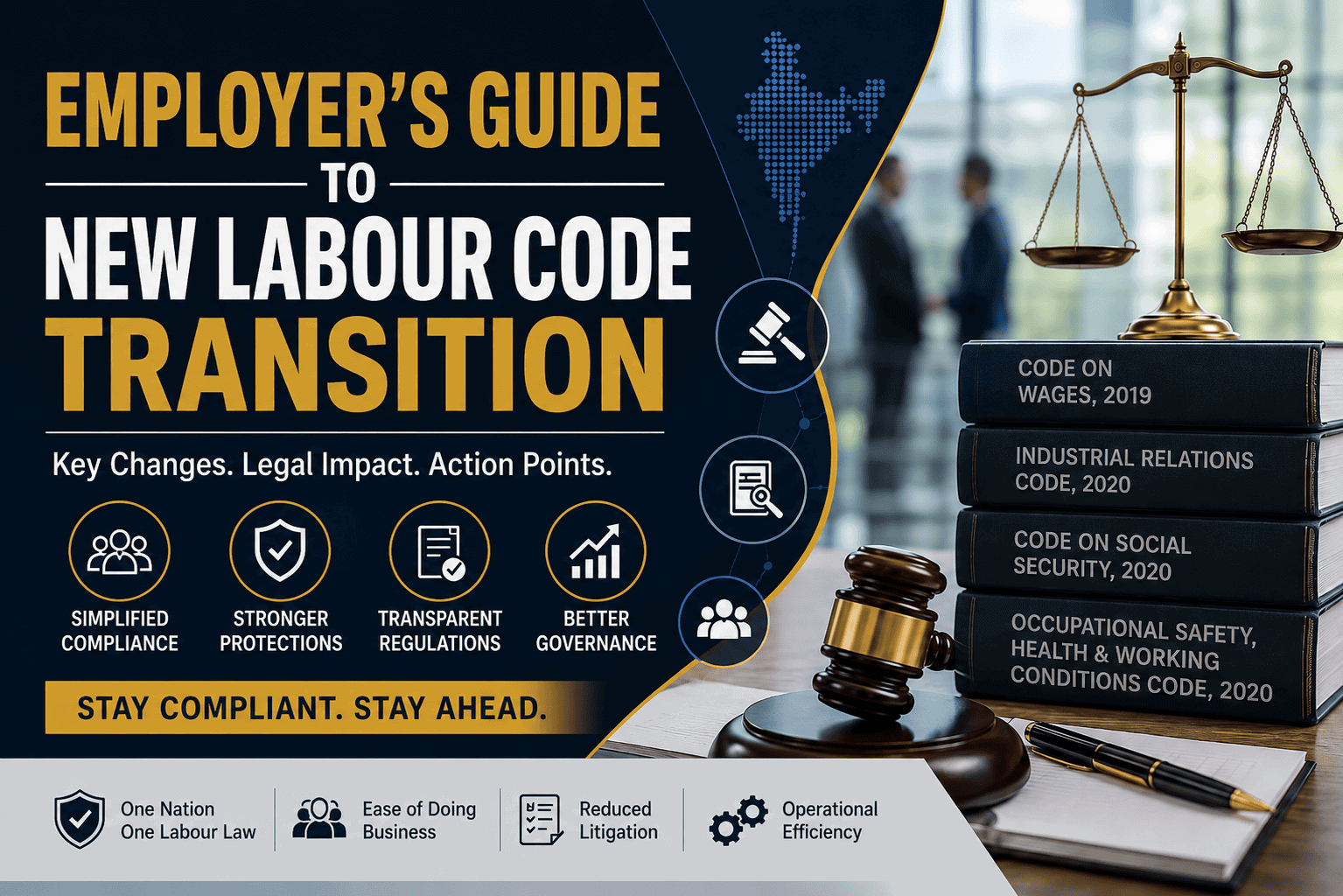
If you read up on India’s labour codes back in late 2025, treat this as a required update, not a repeat. A lot has genuinely changed since then. The codes themselves came into force on 21 November 2025 — but for months afterward, the detailed rules that actually make them enforceable were still in draft. That changed in a major way this year.
Here’s what’s actually different now, and what employers need to act on in 2026.
The Big 2026 Development: Central Rules Are Now Final
On 8 May 2026, the Ministry of Labour and Employment notified the final Central Rules under all four labour codes:- Code on Wages (Central) Rules, 2026
- Social Security (Central) Rules, 2026
- Occupational Safety, Health and Working Conditions (Central) Rules, 2026
- Industrial Relations (Central) Rules, 2026
Where State Rules Actually Stand (July 2026 Status)
This is the detail employers most often get wrong, so it’s worth being precise:- As of mid-2026, over 30 states and Union Territories have notified rules for at least one of the four codes.
- Only around 11 states — including Madhya Pradesh, Uttar Pradesh, Gujarat, Karnataka, Haryana, Uttarakhand, Jharkhand, Odisha, Bihar, Chhattisgarh, and Assam — have finalised rules across the board.
- Maharashtra, Gujarat, and Karnataka are generally cited as furthest along.
- There is still no single, uniform pan-India commencement date for state-dependent provisions. The Ministry continues to push for simultaneous enforcement once major industrial states complete their rule-making, but that hasn’t happened yet.
What Actually Changed With the Final Rules
Retrenchment and Layoff Threshold Raised to 300 Workers
This is one of the most consequential changes for mid-sized and larger employers. Previously, establishments with more than 100 workers needed prior government permission before retrenchment, layoffs, or closure. Under the final rules, that threshold has been raised to 300 workers — meaning many companies that previously needed government sign-off for workforce reductions no longer do. This gives employers materially more flexibility, but it comes with tighter procedural obligations elsewhere (notice periods, compensation calculations, and dispute-resolution timelines), so “no permission needed” doesn’t mean “no process required.”Model Standing Orders, 2026
The final rules notify Model Standing Orders covering worker classification, attendance, leave, discipline, and misconduct procedures — organised into separate schedules for mining, manufacturing, and services sectors. If your establishment doesn’t have customised standing orders of its own, these model orders now serve as the default framework you’re expected to follow.Enhanced Contractor and Principal Employer Obligations
The rules introduce stricter compliance requirements for businesses that engage contract labour, placing more direct responsibility on principal employers to ensure contractor-side compliance — not just on the contractors themselves.New Employee-Facing Requirements
Several provisions specifically strengthen protections for individual workers:- Mandatory annual health check-ups for eligible categories of employees
- Crèche facilities requirements for establishments meeting specified thresholds
- Formalised grievance redressal committees
- Continued emphasis on formal appointment letters for every worker, not just permanent staff
Fixed-Term Employees and Gratuity
Fixed-term employees are now entitled to pro-rata gratuity from day one of service — a meaningful shift from the pre-code norm where gratuity eligibility typically required five years of continuous service. This closes a long-standing gap that made fixed-term hiring artificially cheaper than permanent hiring from a benefits standpoint.What’s Still Pending
Not everything is settled. Two notable gaps remain as of mid-2026:- Floor wage limits by skill category have not yet been notified, even though the framework for a national floor wage is now in place
- Gig worker-specific contribution rules — while the Code on Social Security formally recognises app-based delivery workers, cab drivers, and similar gig-economy participants as eligible for welfare fund benefits, the detailed contribution mechanics are still being worked out
- The Shram Suvidha 2.0 digital compliance portal, expected to centralise filings and reporting under the new codes, has not yet gone live
The 50% Wage Rule: Still the Core of Everything
If this is your first time encountering the labour codes, the single most important structural change remains the uniform wage definition under Section 2(y) of the Code on Wages. In brief:- “Wages” = basic pay + dearness allowance + retaining allowance
- Everything else — HRA, bonus, overtime, conveyance, other allowances, employer PF/pension contributions, gratuity — is excluded, but capped at 50% of total remuneration
- If exclusions exceed that 50% cap, the excess gets added back and counted as “wages” for PF, gratuity, and other statutory calculations
Employer Action Checklist for 2026
- Confirm whether your establishment falls under central or state jurisdiction, and check your specific state’s rule-notification status
- If you’re near the 100–300 worker range, understand how the revised retrenchment/layoff threshold affects your workforce planning
- Review whether your establishment needs customised standing orders, or whether the Model Standing Orders, 2026 now apply to you by default
- Audit CTC structures against the 50% wage rule — this is no longer optional guidance, it’s backed by final rules
- Update gratuity provisioning for fixed-term employees to reflect day-one, pro-rata eligibility
- Review contractor agreements and principal-employer obligations if you engage contract labour
- Confirm annual health check-up and grievance committee requirements apply to your establishment size/sector
- If you engage gig or platform workers, monitor for the pending contribution-rule notifications rather than assuming current obligations are final