
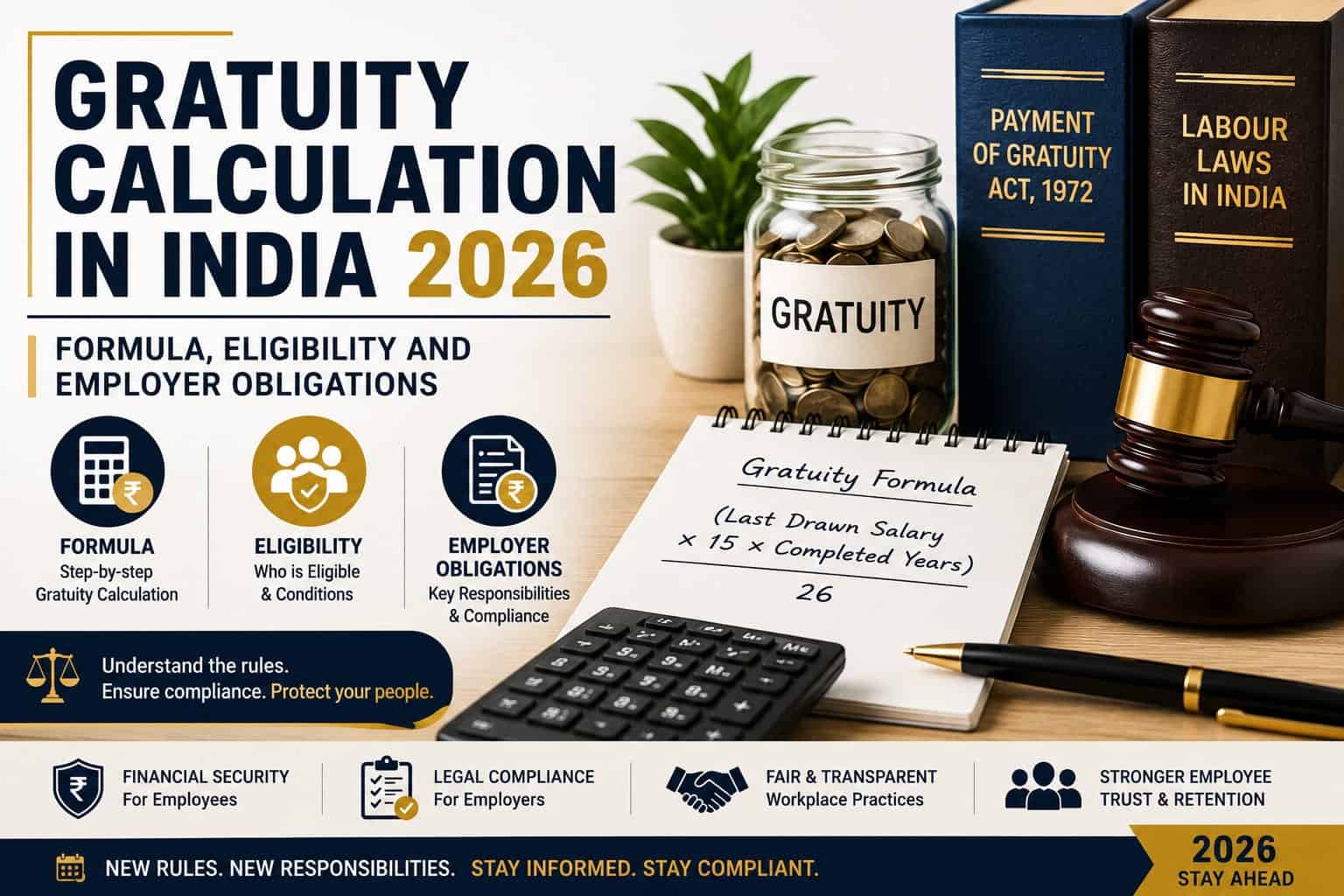
Gratuity looks simple on the surface — a lump-sum thank-you payment for long service. In practice, it’s one of the most common sources of payroll disputes and compliance errors in India, and 2026 has added a genuine layer of complexity on top of the old rules. Between the classic 5-year eligibility rule, a new 1-year rule for fixed-term employees, and a wage definition that’s now pulling more of an employee’s pay into the calculation, HR and payroll teams have real reasons to get this wrong.
Here’s everything an employer needs to know to calculate gratuity correctly and stay compliant in 2026.
What Is Gratuity, and Who Does It Apply To?
Gratuity is a statutory lump-sum payment an employer makes to an employee in recognition of continuous service, payable on retirement, resignation, death, disablement, or termination. It’s governed by the Payment of Gratuity Act, 1972, which now operates alongside the Code on Social Security, 2020 — the labour code that took effect on 21 November 2025 and layers new provisions on top of the original Act rather than replacing its core structure.
Coverage is broad and, once triggered, permanent:
- The Act applies to any factory, shop, or establishment employing 10 or more employee/worker on any day in the preceding 12 months
- Once your establishment crosses that threshold, the Act continues to apply even if your headcount later drops below 10
- This covers private sector, public sector, and government establishments alike
The Standard Eligibility Rule: 5 Years of Continuous Service
For most employees, gratuity becomes payable after 5 years of continuous service — whether the employee resigns, retires, or is terminated for reasons other than misconduct.
Two important exceptions waive the 5-year requirement entirely:
- Death of the employee
- Permanent disablement due to accident or disease
In both cases, gratuity is payable regardless of how long the employee had served, and payment goes to the nominee or legal heir.
A lesser-known nuance: courts have, in several cases, interpreted 240 working days in the fifth year as sufficient to count as a completed year of continuous service — meaning an employee who resigns just short of a literal 5-year anniversary may still be found eligible, depending on how their attendance in that final year is counted. This is genuinely contested ground and worth checking case-by-case with a compliance professional rather than assuming a hard cutoff.
The Big 2026 Change: Fixed-Term Employees Qualify After Just 1 Year
This is the update every employer with contract or fixed-term staff needs to know. Under the Code on Social Security, 2020, fixed-term employees become eligible for gratuity on a pro-rata basis after just 1 year of continuous service — not the 5 years required for permanent employees.
This closes what used to be a real cost advantage of hiring on fixed-term contracts instead of permanent roles. If your workforce includes IT project staff, contractual manufacturing labour, or short-cycle hires generally, this is a direct, material change to your gratuity liability — not a minor technical update.
How the pro-rata calculation works: for a fixed-term employee who leaves after, say, 14 months, gratuity is calculated proportionally based on completed months of service rather than the full-year formula used for employees crossing the 5-year mark.
The Gratuity Formula
For establishments covered under the Act, the standard formula is:
Gratuity = (Last Drawn Basic + DA) × 15 × Years of Service ÷ 26
Breaking this down:
- Last Drawn Basic + DA — the salary base for gratuity. This is not gross salary and not CTC — only Basic Salary plus Dearness Allowance. Using gross salary instead of basic is one of the most common calculation errors HR teams make, and it typically results in overpayment.
- 15 — represents 15 days’ wages for every completed year of service
- 26 — the number of working days used in the divisor, not 30. Using 30 instead of 26 understates the payout by roughly 13%, which is a common and costly mistake.
- Years of Service — completed years, with any period over 6 months typically rounded up to a full year
Worked Example
An employee with a last-drawn Basic + DA of ₹60,000/month, after completing 10 years of continuous service:
Gratuity = (₹60,000 × 15 × 10) ÷ 26 = ₹3,46,154
Notice this is meaningfully higher than what you’d get using 30 as the divisor (₹3,00,000) — a 13%+ difference that matters both for accurate budgeting and for not shortchanging a departing employee.
The ₹20 Lakh Cap and Tax Treatment
- Total gratuity payable is capped at ₹20 lakh, regardless of what the formula produces above that figure
- For private-sector employees, gratuity is tax-exempt up to ₹20 lakh under Section 10(10) of the Income Tax Act — this is a lifetime limit across employers, not a per-employer allowance
- Government employees receive gratuity that is fully tax-exempt, with no ceiling
How the 50% Wage Rule Affects Gratuity Payouts
This is where the new labour codes compound the effect on gratuity specifically. Under the Code on Wages’ uniform wage definition (Section 2(y)), “wages” now must account for at least 50% of an employee’s total CTC — meaning basic pay, DA, and retaining allowance can no longer be structured as a small fraction of overall compensation with the rest pushed into HRA, special allowances, and similar exclusions.
Because gratuity is calculated on Basic + DA, a higher mandated basic pay directly increases the gratuity base. Industry estimates suggest employees could see gratuity payouts 40% to 70% higher than under the old structure, purely because the wage base used in the formula has grown — even with identical years of service. This same shift also raises PF contributions, which typically reduces monthly take-home pay by roughly 2% to 5%, so it’s worth communicating this trade-off clearly to employees rather than letting it come as a surprise on their payslip.
Employer Obligations: What You’re Actually Required to Do
- Determine coverage correctly — confirm whether your establishment is covered (10+ employees at any point) and remember coverage is permanent once triggered
- Maintain accurate service records — continuous service periods, including for fixed-term employees now tracking toward the 1-year threshold
- Collect Form F nominations — employees should submit nomination forms within 30 days of completing one year of service; missing or outdated nominations are a frequent compliance gap, especially in smaller companies, and cause real delays for families in death/disablement cases
- Calculate correctly — using Basic + DA (not gross or CTC), the 15/26 formula, and proper rounding for completed years
- Pay within statutory timelines — gratuity is generally payable within 30 days of it becoming due; delayed payment attracts interest
- Provision for gratuity liability proactively — many companies still treat gratuity as a once-a-year actuarial afterthought rather than an ongoing payroll liability, which creates unpleasant surprises during audits or full-and-final settlements
Penalties for Non-Compliance
Non-compliance with the Payment of Gratuity Act is a criminal matter, not just a financial one. Under Section 9 of the Act, penalties include imprisonment of up to 2 years, a fine of up to ₹20,000, or both — a serious deterrent that many smaller employers underestimate.
Common Employer Mistakes
| Mistake | Why It Happens | Fix |
|---|---|---|
| Using gross salary instead of Basic + DA | Confusing CTC components with the statutory wage base | Always isolate Basic + DA specifically for the gratuity calculation |
| Using 30 as the divisor instead of 26 | Assuming a standard calendar month | Use 26 — it reflects the standard working-day convention under the Act |
| Denying gratuity to employees at 4 years 8+ months | Treating 5 years as a rigid, literal cutoff | Check whether 240 working days in the final year applies, per judicial interpretation |
| Ignoring fixed-term employees entirely | Applying the old 5-year rule uniformly | Track fixed-term service separately toward the new 1-year threshold |
| Missing or outdated Form F nominations | Onboarding gap, rarely revisited later | Build nomination collection into your standard 1-year service milestone process |
| Treating gratuity as a year-end actuarial line item | Reactive rather than proactive provisioning | Track gratuity liability continuously, not just at audit time |
Quick Reference Checklist
- Confirm establishment coverage under the Payment of Gratuity Act (10+ employees, permanent once triggered)
- Track continuous service separately for permanent employees (5-year rule) and fixed-term employees (1-year rule)
- Collect Form F nominations at the 1-year service milestone
- Calculate gratuity using Basic + DA only, with the 15/26 formula
- Confirm CTC structures meet the 50% wage rule, since this directly raises gratuity liability
- Pay gratuity within 30 days of it becoming due
- Provision for gratuity liability continuously rather than as a year-end exercise
- Review death/disablement claims promptly — the 5-year condition doesn’t apply to these
Why This Deserves More Attention Than Most Employers Give It
Gratuity sits at the intersection of two 2026 realities: a genuinely new eligibility rule for fixed-term employees, and a wage definition change that raises the payout for everyone else. Treating it as a once-a-year afterthought — or worse, calculating it with the wrong salary base or divisor — creates real financial and legal exposure. Getting it right protects both your compliance standing and your relationship with departing employees, who are understandably attentive to whether their final settlement is accurate.
Lets SNGSPL Handle Your Gratuity Compliance
Between tracking fixed-term service separately, recalculating liability against the 50% wage rule, and making sure Form F nominations don’t fall through the cracks, gratuity compliance has gotten measurably more complex in 2026. SNGSPL manages end-to-end statutory compliance for growing Indian businesses — including gratuity provisioning, calculation accuracy, and full-and-final settlement support — so nothing slips through during an employee exit. Talk to SNGSPL about a gratuity compliance review for your workforce.
Frequently Asked Questions
Do fixed-term employees really get gratuity after just 1 year?
Yes — under the Code on Social Security, 2020, effective 21 November 2025, fixed-term employees become eligible for pro-rata gratuity after 1 year of continuous service, instead of the 5 years required for permanent staff.
Is gratuity calculated on gross salary or CTC?
Neither. Gratuity is calculated only on Basic Salary plus Dearness Allowance (Basic + DA) — using gross or CTC significantly overstates the payout.
What happens if an employee resigns at 4 years and 10 months?
They generally aren’t eligible under a strict 5-year reading, though judicial interpretation in several cases has treated 240 working days in the fifth year as satisfying the continuous-service requirement. This is worth checking against your specific facts rather than assuming either outcome.
Is gratuity taxable?
For private-sector employees, gratuity is tax-exempt up to ₹20 lakh under Section 10(10) — a lifetime limit, not per employer. Government employees receive it fully tax-exempt.
Why has gratuity gotten more expensive for employers in 2026?
The Code on Wages’ 50% wage rule requires basic pay to make up at least half of CTC. Since gratuity is calculated on Basic + DA, this directly raises the payout — independent of any change to years of service.
Disclaimer: This article reflects publicly available guidance current as of July 2026. Labour code implementation, including state-level rules, continues to evolve. Employers should verify current requirements against the Payment of Gratuity Act, the Code on Social Security, 2020, or a compliance professional before making decisions specific to their establishment.