
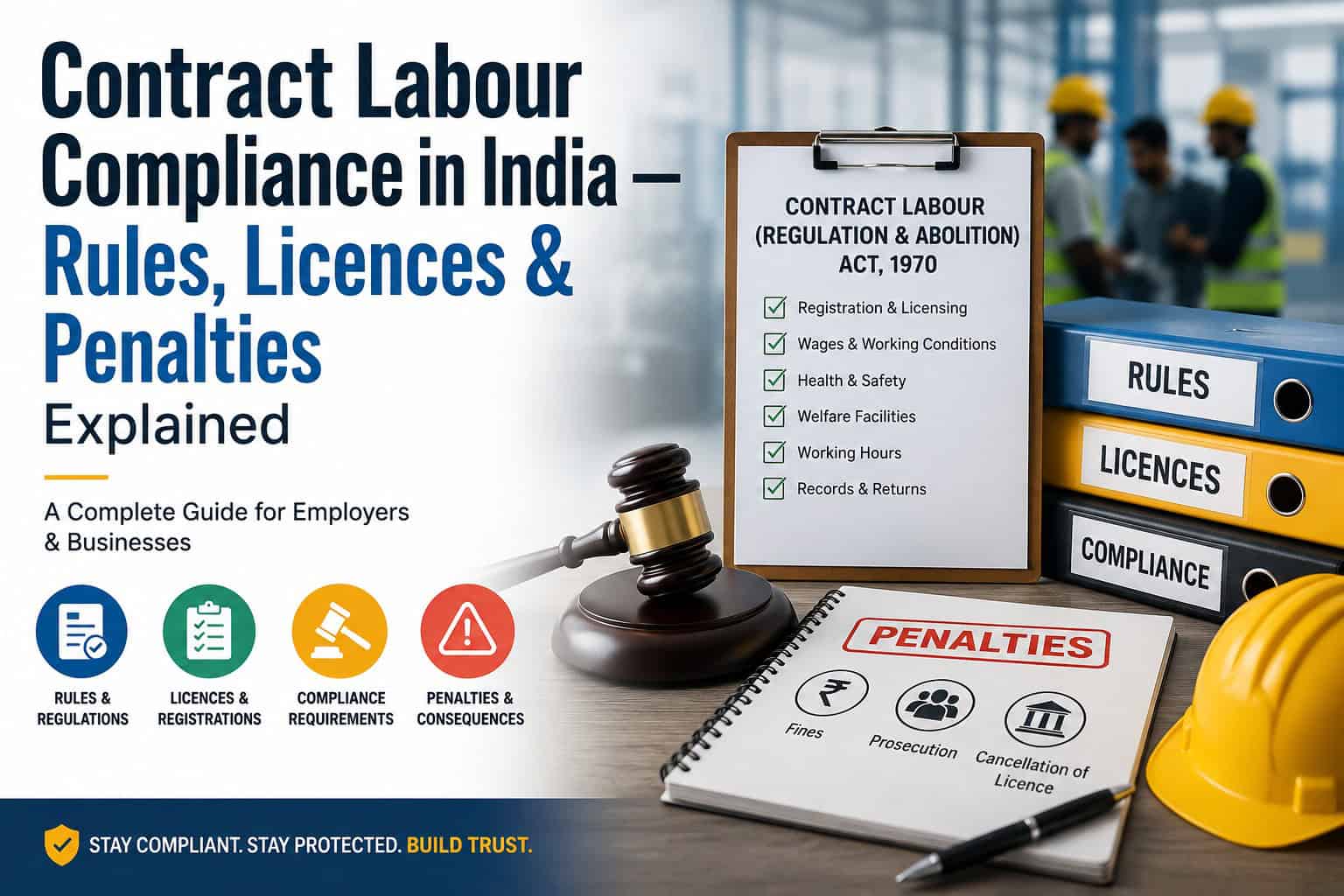
If your business engages housekeeping staff through a vendor, security through an agency, or production labour through a manpower contractor, you’re a principal employer under Indian law — whether you’ve formally registered as one or not. Contract labour compliance is one of the most under-managed areas of Indian employment law, largely because the obligations sit on two parties at once, and many businesses assume the contractor alone carries the legal risk. They don’t.
Here’s a complete breakdown of who’s covered, what licences and registrations are required, what you must maintain and verify on an ongoing basis, and what happens if you get it wrong.
The Legal Framework: Two Laws, One Transition
Contract labour in India currently sits at an important transition point:
- The Contract Labour (Regulation and Abolition) Act, 1970 (CLRA) remains the governing law for most establishments today. It was enacted to regulate the conditions under which contract workers are employed and to prevent businesses from using contracting arrangements to sidestep labour law obligations.
- The Occupational Safety, Health and Working Conditions (OSH) Code, 2020 absorbs the CLRA along with 12 other labour laws, and introduces meaningful changes — but as of mid-2026, its contract-labour provisions are only in force in states that have notified their own OSH Code rules. Central Rules under the OSH Code were finalised on 8 May 2026, but state-level adoption remains uneven, similar to the rollout pattern across the other three labour codes.
Practical takeaway: unless you’ve confirmed your state has notified OSH Code rules, treat the existing CLRA framework as your operative compliance obligation. Don’t assume the newer, more lenient thresholds already apply to you.
Who’s Covered: The Three-Party Structure
Contract labour arrangements involve three distinct parties, each with defined roles:
- Principal Employer — the owner or occupier of the establishment where contract labour works. This includes factories, mines, plantations, commercial establishments, and government departments.
- Contractor — the person or firm that undertakes to supply workers or produce a result through contract labour, and directly employs and pays those workers.
- Contract Worker — the individual employed by the contractor to perform work at the principal employer’s premises.
Applicability Thresholds
- The CLRA applies to any establishment that employs 20/50 (State Specific) or more contract workers on any day in the preceding 12 months.
- It also applies to any contractor who employs 20/50 (State Specific) or more contract workers on any day in the same period.
- Once covered, always covered: if your contract workforce later falls below 20/50 (State Specific), the Act continues to apply. This is a detail many employers overlook and incorrectly assume they’ve “exited” coverage.
- Government departments and PSUs are covered on the same basis as private establishments.
Registration and Licensing: What Each Party Must Do
Principal Employer: Registration
Every principal employer intending to engage contract labour must obtain registration under Section 7 of the CLRA, by submitting Form V (some guidance still references the older Form I terminology — check your state’s current form) to the Registering Officer for your area. This registration is a prerequisite — engaging contract labour without it exposes you to compliance risk regardless of whether your contractor is properly licensed.
Contractor: Licence
Every contractor must obtain a Contractor Licence from the Licensing Officer before deploying any contract workers, by submitting Form IV. Key points:
- Licences are typically issued for 12 months and must be renewed annually, at least 30 days before expiry
- A licence is specific to the establishment and scope of work it names — a licence issued for one client or project doesn’t automatically cover another
The Principal Employer’s Verification Duty
This is where many principal employers fall short. Before allowing any contractor to deploy workers, you’re expected to actively confirm:
- The contractor holds a current, valid licence (request a copy of Form VI-A, the licence certificate)
- The licence specifically names your establishment as the principal employer
- The licence’s validity period hasn’t lapsed
- The number of workers specified in the licence matches or exceeds the number actually being deployed
Simply trusting a contractor’s word that “we’re licensed” isn’t sufficient — and if an inspection reveals your contractor’s licence doesn’t cover your establishment or has expired, you carry direct exposure as the principal employer.
Statutory Registers and Returns
Both principal employers and contractors are required to maintain specific statutory registers, available for inspection at any time:
| Form | Register |
|---|---|
| Form XII / XIII | Register of contractors / Register of persons employed |
| Form XVI | Muster roll |
| Form XVII | Register of wages |
| Form XVIII | Register of deductions, fines, and advances |
| Form XIX | Overtime register |
| Form XX | Wage slips — issued to every worker on the day wages are paid |
| Form XXIII / XXIV | Annual return (typically due by 15 February) |
Note – This can be vary from state to state.
Contractors are also required to display notices covering employment conditions, working hours, wage rates, and wage payment dates at the worksite, in a form workers can actually understand.
Principal Employer Liability: The “Guarantor” Provision
This is the single most important thing for principal employers to internalise: under Section 21 of the CLRA, if a contractor defaults on paying wages, the principal employer is directly liable to pay them. The law effectively treats you as a guarantor of the contract workforce’s wages, not a bystander to the contractor’s obligations.
Practically, this means principal employers should:
- Monitor wage disbursement actively — request access to payslips and payment proof, not just take the contractor’s word for it
- Maintain records of amounts paid to the contractor and evidence that those funds reached workers
- Treat wage monitoring as an ongoing compliance function, not a one-time onboarding check
The “Sham Contract” Risk
If a contract labour arrangement is found to be a sham or camouflage — meaning the principal employer actually directs and supervises the workers as if they were direct employees, rather than the contractor genuinely controlling the work — the contract workers can be deemed direct employees of the principal employer. This carries significant retrospective liability, including potential regularisation claims. Under the Industrial Relations Code, 2020, this sham-contract pathway is also where a contract worker can raise a dispute directly against the principal employer, which isn’t otherwise automatically available to them.
What Changes Once the OSH Code Applies in Your State
Where the OSH Code has been notified, the framework shifts in several ways:
- Higher applicability threshold: the registration threshold for principal employers moves to 50 workers, up from 20 under the CLRA
- Unified, potentially pan-India licensing: contractors operating across multiple locations may be able to obtain a common licence rather than a separate licence per state
- Licence linked to the work order period in some cases, rather than a fixed annual renewal cycle regardless of contract duration
- Single registration portal consolidating registration, licensing, and returns across multiple labour laws into one digital process
- “Core activity” restrictions: the OSH Code defines certain core business activities where contract labour cannot be deployed at all, with specific exceptions for genuine outsourcing arrangements
- A dedicated Social Security Fund for contract workers, extending welfare coverage
- Meaningfully higher penalties — reportedly up to ₹2 lakh for first-time offenders and ₹5 lakh for repeat violations, a sharp increase from the CLRA’s decades-old penalty structure
Important: don’t assume any of these provisions already apply to your business. Confirm your specific state’s OSH Code rule-notification status before changing your compliance approach.
Penalties for Non-Compliance
Under the existing CLRA framework, penalties for operating without proper registration or licensing include imprisonment of up to 3 months, a fine of up to ₹1,000, or both, with a continuing default penalty of ₹100 per day. On paper, these figures look dated and modest by 2026 standards — but the real financial exposure for non-compliant employers is rarely limited to CLRA penalties alone. Contract labour violations frequently surface alongside related failures — unpaid PF and ESIC contributions, minimum wage shortfalls, and gratuity liability — and those combined penalties, interest, and potential regularisation costs can add up to a far larger number than the CLRA fine in isolation.
Common Employer Mistakes
- Assuming the contractor alone is liable for compliance — Section 21 makes the principal employer directly responsible for wage defaults
- Not verifying licence scope — accepting a contractor’s licence without confirming it names your specific establishment
- Letting registration lapse silently — assuming coverage ends once headcount drops below 20/50 (State Specific), when it doesn’t
- Treating contract labour as a way to avoid “core activity” obligations — a pattern the OSH Code specifically targets, and one that already invites sham-contract scrutiny under existing law
- Inconsistent register maintenance — missing or incomplete Form XVI–XX registers are a common, easily avoidable inspection finding
- Assuming OSH Code’s more favourable thresholds already apply — before your state has actually notified its rules
Employer Compliance Checklist
- Confirm whether your establishment crosses the 20-worker CLRA threshold (or 50, only if your state has notified OSH Code rules)
- Obtain and maintain principal employer registration under Section 7
- Verify every contractor’s licence names your specific establishment before work begins
- Confirm licence validity dates and renewal status at least 30 days before expiry
- Maintain complete statutory registers (Forms XII–XX) and file annual returns by 15 February
- Actively monitor wage disbursement to contract workers, not just at onboarding
- Review contractor agreements for genuine independence — avoid arrangements that could be read as a sham contract
- Track your state’s OSH Code rule-notification status before assuming updated thresholds or penalties apply
Why This Deserves Proactive Attention
Contract labour compliance often gets deprioritised because the contractor is technically the direct employer — but Indian law deliberately doesn’t let principal employers off the hook that easily. Between the wage guarantor provision, sham-contract risk, and a pending shift to significantly higher OSH Code penalties, this is an area where a light-touch, “the vendor handles it” approach creates real exposure.
Let SNGSPL Manage Your Contract Labour Compliance
Verifying contractor licences, maintaining statutory registers, monitoring wage disbursement, and tracking which of your states have moved to OSH Code rules is genuinely complex to manage without dedicated bandwidth. SNGSPL supports growing Indian businesses with end-to-end contract labour compliance — registration, licence verification, register maintenance, and inspection readiness — so you’re never caught exposed as the principal employer. Talk to SNGSPL about a contract labour compliance review for your business.
Frequently Asked Questions
Am I a “principal employer” even if I don’t directly employ contract workers?
Yes. If contract workers perform work at your establishment through a contractor — housekeeping, security, manpower supply, or similar — you’re the principal employer under the CLRA, regardless of whether you’ve formally registered.
What happens if my contractor doesn’t pay workers on time?
Under Section 21 of the CLRA, you as the principal employer are directly liable to ensure wages are paid if the contractor defaults. This isn’t optional oversight — it’s a statutory obligation.
Does the 20/50 (State Specific) worker threshold reset if my contract workforce shrinks?
No. Once your establishment or contractor crosses the 20/50 (State Specific) worker threshold, CLRA coverage continues even if the number later falls below 20/50 (State Specific).
Has the OSH Code already replaced the CLRA?
Not uniformly. The OSH Code’s Central Rules were finalised in May 2026, but state-level notification is still incomplete as of mid-2026. Until your specific state notifies its OSH Code rules, the existing CLRA framework continues to apply.
What’s the real risk of treating contract labour informally, without proper licensing?
Beyond CLRA penalties themselves, informal arrangements risk being reclassified as sham contracts — making contract workers direct employees with full retrospective entitlements — plus exposure to stacked penalties across PF, ESIC, and minimum wage non-compliance.
Disclaimer: This article reflects publicly available guidance current as of July 2026. OSH Code implementation varies by state, and provisions described as “pending” may already be in force in some jurisdictions. Employers should verify current requirements against the CLRA, the OSH Code, 2020, their state labour department, or a compliance professional before making decisions specific to their establishment.